How to monitor construction site quality ? A practical 6-step method
On a construction site, small quality issues can quickly become expensive: an outdated drawing, a missed inspection, a non-compliant material or a defect that no one formally tracks. Once the next trade starts or an element is covered, correction often means rework, delays and client dissatisfaction.
According to the Construction Industry Institute, quality deviations resulting in rework, repair or replacement represented an average of 12.4% of total installed project cost in the industrial projects studied.
This guide explains how to monitor construction site quality with a practical method based on clear standards, site inspections, documentation, corrective actions, real-time data and continuous improvement.
Manage quality issues faster with Archipad’s management of observations feature.
Key takeways
Construction site quality monitoring helps detect defects early, before they lead to costly rework, delays or client dissatisfaction.
A reliable quality process starts with clear standards, including approved drawings, specifications, building codes and client requirements.
Regular site inspections, checklists, photos and reports are essential to prove that construction activities have been properly checked.
Every quality issue should be documented, assigned to the right person and tracked through corrective actions until it is fully resolved.
Real-time data and construction management software help project managers centralize information, improve visibility and drive continuous improvement.
What does construction site quality monitoring mean?
Construction site quality monitoring is the process of checking that the work performed on site complies with approved drawings, specifications, building codes, client requirements and internal quality standards.
It covers every element that can affect the final quality of the project, including:
materials used on site;
workmanship and installation methods;
dimensions, tolerances and finishes;
compliance with drawings and building codes;
documentation, photos, reports and approvals;
follow-up of quality issues and corrective actions.
In practice, it means verifying that the work is compliant, proving it with reliable evidence and making sure every defect is tracked until it is resolved.
Quality monitoring combines quality assurance and quality control in construction. Quality assurance prevents defects through clear standards and procedures, while quality control detects and corrects issues through inspections, reports and follow-up. Both are essential to avoid interpretation, missed defects and costly rework.
Why quality monitoring matters on construction projects
Poor quality is not only a technical problem. It affects cost control, scheduling, productivity, reputation and client satisfaction.
When project managers monitor construction site quality consistently, they can:
detect defects before they affect several trades;
reduce costly rework and delays;
improve coordination between team members;
create a clear audit trail;
support decisions with reliable field data;
improve trust with clients and stakeholders.
Quality monitoring also reduces confusion. On many construction projects, information is scattered between emails, spreadsheets, phone photos, paper notes and messaging apps. This makes it difficult to know what has been checked, what still needs attention and who is responsible for each corrective action.
A structured process gives everyone the same source of truth. Site managers know what to inspect. Subcontractors know what to fix. Project managers know which quality issues are open, overdue or recurring.
The 6-step method to monitor construction site quality
The most effective approach is not complicated. It is a repeatable process that field teams can follow every day.
To monitor construction site quality effectively:
Define quality standards and acceptance criteria.
Prepare inspection checklists and Inspection & Test Plans (ITPs).
Perform inspections at every critical stage.
Document observations with photos and reports.
Assign corrective actions or Non-Conformance Reports (NCRs) and verify completion.
Analyze quality data to improve future projects.
Step 1: define quality standards before work starts
Quality cannot be monitored properly if nobody has defined what “acceptable” means.
Before each phase, project managers should clarify the criteria for the relevant construction activities. These criteria may come from specifications, drawings, building codes, manufacturer instructions or client requirements.
A useful quality standard should specify:
what must be checked;
which tolerance is acceptable;
which drawing or document applies;
who validates the work;
what evidence is required;
what happens if the work is not compliant.
For example, “check wall installation” is too vague. A clearer standard would mention alignment, fixing method, acoustic requirements, fire rating, surface finish and compliance with the approved drawing.
The more precise the standard, the easier it is to inspect the work fairly and consistently.
Step 2: prepare checklists for each construction activity
A generic checklist is rarely enough. Each trade has its own risks and control points.
Construction activity | Examples of checks |
Concrete works | Formwork, reinforcement, dimensions, curing, surface quality. |
Waterproofing | Substrate, overlaps, upstands, penetrations, protection. |
Electrical works | Routing, labeling, fixing, testing, drawing compliance. |
Finishes | Alignment, joints, surface quality, cleanliness, protection. |
HVAC systems | Positioning, access, connections, insulation, coordination. |
Checklists help team members avoid relying on memory. They also make site inspections more consistent across different teams, subcontractors and construction projects.
The goal is not to create paperwork. The goal is to make inspections faster, clearer and easier to document.
Step 3: run regular site inspections
Site inspections are the foundation of quality control in construction. They allow teams to verify the work while it is still visible and easier to correct.
Inspections should be planned around key project milestones and high-risk activities. Some checks must happen before work begins, such as verifying materials or confirming that the latest drawings are available. Others must happen during execution, before elements are covered. Final inspections confirm that defects have been corrected before handover.
A strong inspection routine includes:
pre-work inspections;
in-progress inspections;
hold-point inspections before work is covered;
final inspections;
follow-up inspections after corrective actions.
The best inspections happen at the right moment, not only at the end of the project.
Step 4: document every quality issue with evidence
A quality issue that is not documented properly is difficult to manage. It can be forgotten, misunderstood or disputed.
Each defect should be recorded with:
a clear description;
location on the plan;
date of observation;
related trade or subcontractor;
priority level;
reference drawing or specification;
expected corrective action;
deadline and status.
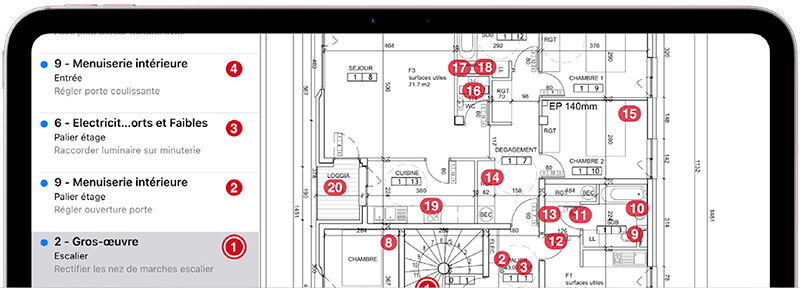
Photos are especially useful because they reduce ambiguity. A comment can be interpreted in different ways, but a photo linked to a precise location and construction activity makes the issue easier to understand.
This is where document management becomes essential. Plans, photos, reports, checklists and approvals should be centralized so project managers and site teams can retrieve the right information quickly.
Step 5: assign corrective actions and track them to closure
Finding a defect is only useful if it leads to action.
Each quality issue should become a corrective action with a responsible person, a deadline and a status. Without this structure, defects often remain stuck in informal conversations.
A reliable workflow is simple:
Stage | Action |
Detect | The issue is found during a site inspection. |
Document | Evidence is added: photo, note, location and reference. |
Assign | A responsible person or subcontractor is identified. |
Correct | The issue is fixed. |
Verify | The correction is inspected. |
Close | The issue is closed only when compliant. |
This process improves accountability. Project managers can see which corrective actions are open, overdue or blocking progress. Team members know exactly what is expected from them.
Step 6: analyze quality data for continuous improvement
Quality monitoring should not stop when defects are closed. The data collected on site can help improve future construction projects.
Project managers should regularly review:
recurring quality issues;
overdue corrective actions;
inspection pass rates;
rework trends;
defects by trade or subcontractor;
average time to closure.
This data driven approach helps identify weak points in processes, training, coordination or documentation. It also supports continuous improvement by turning field experience into better standards, checklists and decisions.
What should be checked during site inspections?
A good site inspection does more than look for visible defects. It verifies whether the work is technically compliant, properly coordinated and ready for the next step.
Inspection area | What to verify |
Materials | Approved products, condition, storage, certificates if required. |
Workmanship | Installation quality, tolerances, alignment, finish. |
Compliance | Drawings, specifications, building codes, client requirements. |
Coordination | Interfaces between trades, sequencing, access, clashes. |
Documentation | Photos, reports, tests, checklists, approvals. |
Protection | Completed work protected before the next trade starts. |
Particular attention should be paid to interfaces between trades. Many quality issues appear where systems meet: structure and facade, waterproofing and finishes, electrical works and partitions, HVAC and ceilings.
These areas often create expensive problems because one defect can affect several construction activities.
How real-time data improves construction quality control
Traditional quality monitoring often suffers from delays. A site manager notices an issue, takes a picture, writes notes later, prepares a report and waits for feedback. By then, the situation on site may already have changed.
Real-time data shortens this loop. When observations, photos, site inspections and corrective actions are recorded directly from the field, project managers can identify urgent quality issues, prioritize decisions and follow progress without waiting for the next meeting.
Real-time visibility helps construction teams:
detect recurring defects earlier;
prioritize urgent issues;
track overdue corrective actions;
connect field observations with management decisions;
improve communication between office and site teams.
The value of real-time data is not collecting more information. It is helping the right person make the right decision at the right time.
Why construction management software makes quality monitoring easier
Quality monitoring becomes harder when information is scattered across notebooks, spreadsheets, emails, phone galleries and disconnected folders. Teams lose time searching for evidence, checking the latest version of a document or confirming whether a quality issue has been resolved.
Construction management software centralizes inspections, documents, photos, reports, quality issues and corrective actions in one place. Project managers gain clearer visibility across construction projects, while site teams can record observations directly from the field.
The right tool does not replace field expertise. Quality still depends on clear standards, experienced professionals and disciplined follow-up. But software makes quality control easier to apply, track and prove.
How to turn quality monitoring into continuous improvement
The strongest construction companies do not treat quality monitoring as a final control. They use it as a learning system.
After each phase, project managers should review the data collected on site and ask:
Which quality issues appeared most often?
Which construction activities caused the most rework?
Which corrective actions were repeatedly overdue?
Were some defects caused by unclear drawings or specifications?
Did team members have the right information at the right time?
These insights help improve future construction projects. Checklists can be updated, acceptance criteria can be clarified and subcontractors can receive better instructions before recurring defects happen again.
How Archipad helps teams monitor construction site quality
Archipad helps project managers and site teams centralize quality monitoring in one intuitive tool.
With Archipad, teams can:
document quality issues with photos, notes and locations;
assign corrective actions to the right team members;
track progress in real time;
centralize reports, plans and inspection data;
keep a clear record of what has been checked and resolved.
This gives construction companies better visibility, fewer missed defects and a more reliable quality control process.
Conclusion
Monitoring construction site quality means acting before defects become expensive. With clear standards, regular inspections, documented evidence, corrective actions and real-time data, project managers can keep quality under control throughout the project.
The result is fewer surprises, less rework, better coordination between team members and stronger client satisfaction.
FAQ
1. How do you control quality in construction?
Quality in construction is controlled by setting clear standards before work starts, using inspection checklists, documenting issues and tracking corrective actions until they are resolved. Project managers should monitor construction activities regularly to ensure they comply with drawings, specifications and building codes. A structured process helps reduce rework, delays and quality disputes.
2. How to check the quality of construction?
Construction quality is checked through regular site inspections, material verification, workmanship reviews and documentation. Teams should compare the work with approved drawings, specifications, building codes and client requirements. Photos, reports and checklists help prove that the work has been inspected and that any quality issues have been corrected.
3. What is QA or QC in construction?
In construction, quality assurance, or QA, focuses on preventing defects before they happen through standards, procedures, planning and checklists. Quality control, or QC, focuses on detecting and correcting defects during construction through site inspections, reports, tests and corrective actions. QA defines the process; QC verifies the result on site.
4. Who is responsible for construction site quality?
Construction site quality is a shared responsibility. Project managers define the quality process, site managers monitor daily execution, subcontractors deliver compliant work and team members report issues when they appear. However, the project manager or site manager usually ensures that inspections, documentation and corrective actions are properly followed.
5. What are the 5 key performance indicators in construction?
Five useful construction quality KPIs are open quality issues, overdue corrective actions, inspection pass rate, rework rate and average time to closure. These indicators help project managers identify recurring defects, measure team performance and improve future construction projects. They also support a more data driven approach to quality control.